
A tax credit a lot of people think still exists
If you’ve started researching solar in the past year, you’ve probably run into a claim that the federal government will cover 30 percent of the cost. That claim was true for a long time. It stopped being true for homeowner-purchased systems at the end of 2025.
The federal Residential Clean Energy Credit, Section 25D of the tax code, let a homeowner claim 30 percent of a system’s cost back on their taxes, with no cap. It also covered standalone battery storage of at least 3 kilowatt-hours, on its own, separate from any solar purchase. That’s changed now, and the change is worth understanding precisely rather than approximately, because the details of what counts and what doesn’t are where most of the confusion lives.
The law that ended it
The One Big Beautiful Bill Act became law on July 4, 2025. It repealed Section 25D for expenditures made after December 31, 2025. The IRS has published FAQ guidance working through exactly what that means, and it’s more specific than a simple calendar cutoff.
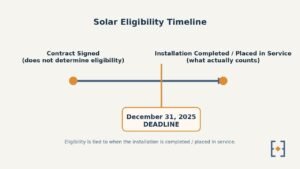
Under the underlying statute, an expenditure counts as made when the original installation of the item is completed and the system is operational, what the IRS refers to as placed in service. Not when a contract was signed. Not when a deposit changed hands.
Why the contract-date assumption trips people up
A homeowner who signed a contract in November 2025 might reasonably assume they’re covered because they acted before the deadline. Under the guidance the IRS has published, that assumption doesn’t hold. If the system wasn’t fully installed and operational by December 31, 2025, the credit isn’t available for it, regardless of when the paperwork was signed.
This article isn’t going to tell you where you personally stand if your installation spanned that period. Installation timelines, documentation, and specific circumstances vary enough that this is a question for a qualified tax professional who can look at your actual paperwork, not something a general article can answer for you.
If your system did qualify
Systems installed and placed in service on or before December 31, 2025 kept their eligibility, and the credit’s existing carryforward rule still applies to them under current law: unused amounts can carry forward to future tax years. The repeal changed which new expenditures qualify. It didn’t undo credit that was already earned. How carryforward applies to a specific return is, again, a tax professional’s question.
What’s different about the math now
None of this means solar stopped making sense in Illinois. It means one input changed. Illinois still runs Illinois Shines, its own incentive program built around renewable energy credits, structured differently from a tax credit and worth learning on its own terms. Net metering rules for how your utility credits exported electricity also shifted recently, for reasons unrelated to the federal change. A realistic 2026 estimate has to account for both.
Talk to someone who can run your numbers
This article isn’t tax advice, and it isn’t going to hand you a savings figure. What a solar quote can do is walk through your specific roof, your usage, and the current Illinois incentive picture with you directly.
Request your solar quote through SolarSiteIQ to see what the current numbers look like for your home.
Frequently asked questions
Is the federal solar tax credit completely gone?
For homeowner-purchased residential systems, yes, for anything placed in service after December 31, 2025.
I signed a contract in 2025. Am I covered?
Not automatically. What determines eligibility is when installation was completed and the system was operational, not the contract date. Confirm your specific situation with a qualified tax professional.
Did the battery storage credit end too?
Yes, for the same reason. Standalone battery storage of at least 3 kWh was independently eligible under Section 25D before the repeal, and that eligibility ended on the same date as the solar credit.
