
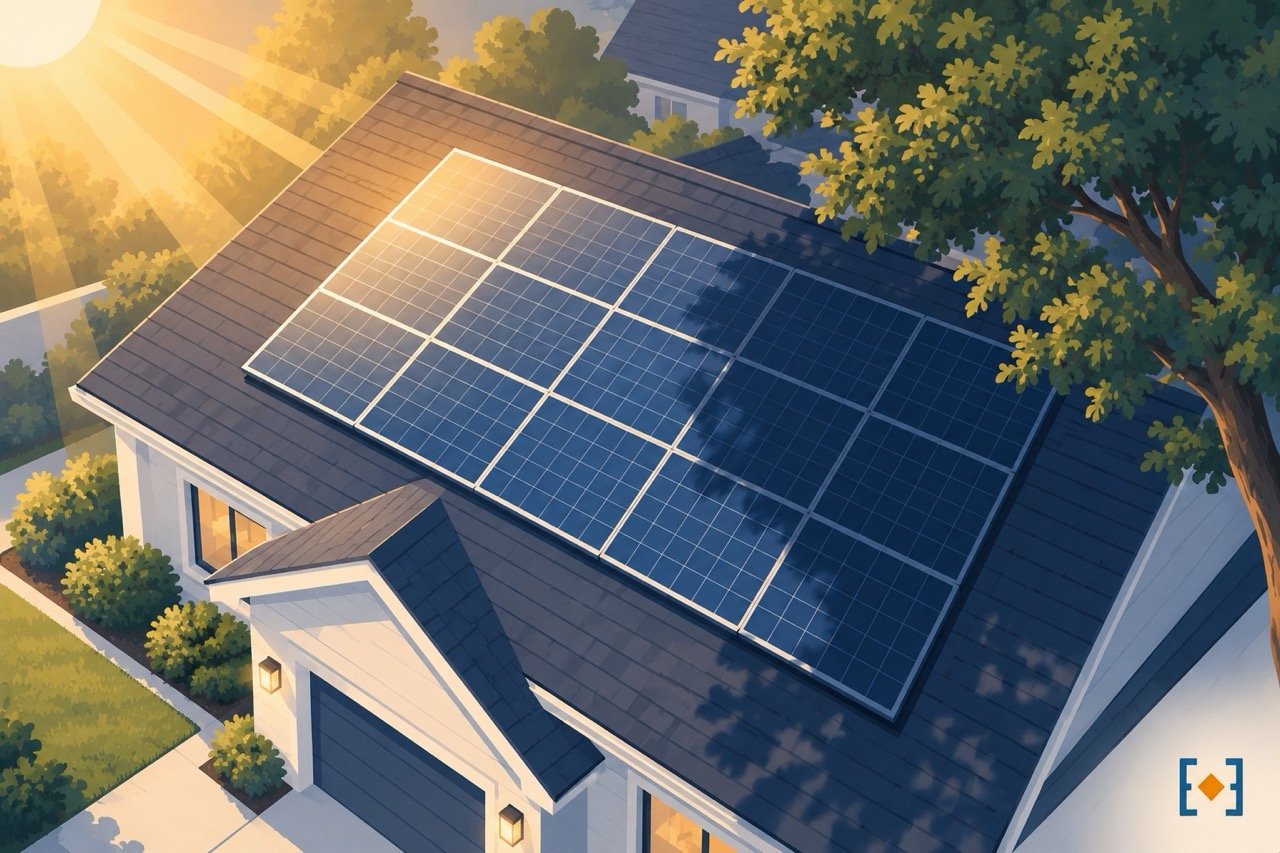
What to check before you call anyone
Not every roof is an equally strong candidate for solar, and knowing the basics before talking to an installer means asking better questions and understanding the answers, rather than just taking someone’s word for it. None of this replaces a real site assessment. Think of it as a starting checklist.
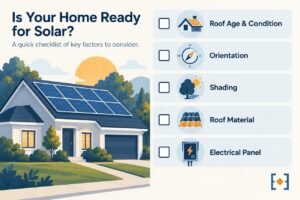
Roof age and condition
Roof condition is one factor a lot of homeowners overlook, and it’s worth taking seriously alongside everything else on this list, not instead of it. Installing solar on a roof that needs replacing within a few years usually means removing and reinstalling the system later, or living with an aging roof under an asset you’d rather not disturb. Most installers ask about roof age and condition early for exactly this reason. If a roof is nearing the end of its expected life, it’s worth discussing replacement timing before installation, not after.
Orientation
The Department of Energy’s guidance treats south-facing roof sections as a common preference because they tend to see consistent sun exposure across the day. That’s a general pattern, not a fixed rule. Roof pitch, local shading, the household’s actual usage pattern, and the specific rate structure a system will be credited under can all shift what orientation actually performs best for a given home. East or west-facing sections can produce meaningful electricity too, with a different daily production curve, and depending on when a household uses the most electricity, that different curve isn’t automatically a downgrade.
Shading
A tree that looks like a minor inconvenience from the ground can measurably reduce a panel’s output if it shades part of the array during peak sun hours, and partial shading on even one panel can, depending on the equipment used, affect more of the array’s output than just that one panel. This is exactly the kind of thing a real site assessment measures directly, modeling the sun’s path across a specific roof over a full year, rather than a guess based on how much shade is visible on one afternoon.
Roof material
Common residential roofing materials, including asphalt shingle, standing-seam metal, and tile, can generally support solar installations, though the mounting approach and cost can differ by material. Some materials are more involved to work with than others, which is a fair question to bring to an installer directly if a home has anything other than standard asphalt shingle.
Electrical panel
An electrical panel’s age alone doesn’t automatically mean it needs an upgrade for solar. What matters is capacity: whether the panel has enough headroom for the added electrical load once existing home usage is accounted for. Some homes with older panels have plenty of capacity; some newer panels are already near their limit from other electrical loads. This is a detail worth asking an installer to check directly rather than assuming either way based on age.
What a real assessment checks that a checklist can’t
A proper site assessment measures actual usable roof area, checks structural condition, models shading across a full year using the home’s real coordinates, and reviews electrical panel capacity directly. None of that is reliably estimated by eye, which is why “is my roof right for solar” is ultimately a question for an actual site visit.
Request your solar quote through SolarSiteIQ to have a participating installer assess your specific roof.
Frequently asked questions
Does my roof have to face south for solar to make sense?
No. South-facing exposure is a common preference, but east and west-facing sections can still produce meaningful electricity with a different daily production pattern, and the best fit depends on more than orientation alone.
How old is too old for a roof to get solar?
There’s no universal cutoff. If a roof is likely to need replacement within the next several years, it’s worth discussing timing with an installer before installation.
Does an older electrical panel need to be replaced for solar?
Not automatically. What matters is whether the panel has enough remaining capacity for the added load, which an installer can check directly.
