
The decision that shapes the whole project
By the time you’re comparing installers, you’ve likely already decided solar makes sense for your home. Who you hire from there affects how the project actually goes more than any spec-sheet comparison between panel brands. Here’s what’s worth checking before signing anything, broken into the separate things it actually involves.
Company certification: what Illinois requires
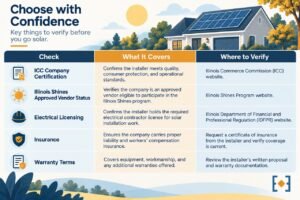
Since December 31, 2013, Illinois has required distributed generation installers, meaning any company installing solar in the state, to be certified by the Illinois Commerce Commission, with a narrow exception for homeowners installing their own system. This is a legal requirement, not a marketing distinction, and it’s a fair, reasonable question to bring to any company you’re evaluating: is your company currently ICC-certified as a distributed generation installer? A company that can’t answer that clearly is worth a second look, though there can be legitimate reasons a smaller or newer company might work under another firm’s certification, which is itself worth asking about directly.
Recognized paths to certification include a track record of prior installations, a registered electrical apprenticeship program, an accredited community college program, or a recognized industry training program. Confirming a specific company’s current status may mean asking the company directly, since the Commission’s certification records are filed through its Chief Clerk’s office, not a single public search tool.
Illinois Shines participation is a separate question
ICC certification and Illinois Shines Approved Vendor status aren’t the same thing. Illinois Shines maintains its own directory of Approved Vendors, Designees, and Subcontractors, which is worth checking if participating in that program matters to your project’s economics, which for most residential projects it does. Ask specifically whether a company is an Approved Vendor or works under one, rather than assuming ICC certification alone covers program participation.
Individual credentials versus company certification
You’ll see some installers advertise individual staff credentials from organizations like NABCEP. These can be a meaningful signal of training and experience, and Illinois does recognize some of these programs as one path toward a company’s ICC certification. They aren’t, on their own, a separate legal requirement layered on top of that certification. Don’t treat the absence of an optional individual credential as disqualifying, and don’t assume having one substitutes for a company’s actual ICC status.
Electrical work and local permits
Installation involves electrical work that, depending on scope, may need to be performed or supervised by an appropriately licensed electrician under local jurisdiction requirements, which is a separate matter from DG installer certification itself. Permitting requirements vary by municipality too. Ask directly who handles permitting and, if it isn’t the installer, confirm what you’re responsible for before signing.
Insurance and warranties
Ask about liability insurance coverage, and get warranty terms in writing for both the equipment and the installer’s own workmanship. Equipment warranties typically come from the manufacturer; workmanship warranties come from the installer and vary by company. If a quote doesn’t spell out what’s covered and for how long, ask before signing, not after something goes wrong.
Questions worth bringing to any installer conversation
- Is your company currently ICC-certified as a distributed generation installer?
- Are you an Illinois Shines Approved Vendor, or do you work under one?
- Who performs the electrical work, and are they licensed appropriately for that scope?
- What does your workmanship warranty cover, and for how long?
- Who handles permitting with my municipality?
Comparing more than one company
Getting quotes from more than one installer is generally worth doing before committing, the same way it’s worth doing for most major home projects. It gives you a basis for comparison rather than relying on one company’s framing of what your project should cost.
Request your solar quote through SolarSiteIQ to connect with a participating installer serving your area, and bring the questions above into that conversation.
Frequently asked questions
Is ICC certification the only thing I need to check?
It’s the baseline legal requirement. Illinois Shines participation, licensing for the electrical work, insurance, and warranty terms are separate things worth verifying on top of it.
Do all installers need NABCEP certification?
No. NABCEP and similar programs are one recognized path toward a company’s ICC certification and can be a useful signal, but they aren’t themselves a separate mandatory requirement.
Who handles permits and inspections?
This varies by company. Ask directly whether the installer manages permitting with your municipality or whether that falls to you, and get it in writing either way.
