
Massachusetts still has real, active solar incentives in 2026. What changed is the federal picture behind them, and that changes what a homeowner should actually expect a quote to include.
What changed for 2026
The federal Residential Clean Energy Credit, Section 25D of the tax code, let a homeowner claim 30 percent of a system’s cost back on their taxes. The One Big Beautiful Bill Act repealed that credit for property placed in service after December 31, 2025. Eligibility was always tied to when installation was actually completed, not to when a contract was signed or a deposit was paid, so a 2025 contract alone did not preserve it once the calendar turned. For a system placed in service in 2026 or later, this credit generally does not apply.
That single change makes Massachusetts’ own state-level programs, which never depended on the federal credit, worth understanding on their own terms.
SMART: the state production incentive
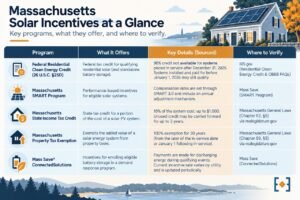
SMART (Solar Massachusetts Renewable Target) is the state’s primary solar production incentive, run by the Department of Energy Resources. A redesigned version, SMART 3.0, began accepting applications for the 2026 program year. Under it, the state now adjusts incentive rates annually rather than fixing them in advance, so the current rate is best confirmed at the time a quote is signed rather than assumed from an older article or brochure. A homeowner does not apply for SMART directly; the installer files the application as part of the project.
SMART is only available to customers of the three investor-owned utilities: Eversource, National Grid, and Unitil. Customers of a municipal light plant, roughly 41 towns run their own, are not eligible for SMART itself, though some municipal light plants offer a separate incentive of their own with different terms.
If you have heard Massachusetts described in terms of SRECs, that is describing an older, closed program. The Solar Carve-out (SREC-I) and Solar Carve-out II programs stopped accepting new projects years ago; SMART replaced them. A quote that talks about earning SRECs today is describing something that is not available to a new applicant.
Massachusetts tax treatment, separate from the federal credit
Massachusetts has its own incentives that are unaffected by the federal credit’s expiration:
- Sales tax exemption. Equipment for a solar, wind, or heat pump system serving a principal residence is fully exempt from the state’s 6.25 percent sales tax, under Massachusetts law. An installer typically handles this at the point of sale.
- Property tax exemption. The added value a solar system contributes to a home is exempt from local property tax assessment for 20 years from installation, with no application needed from the homeowner.
- State income tax credit. Massachusetts offers its own credit, separate and much smaller than the former federal one: 15 percent of net system cost, capped at $1,000, claimed on the state return and carried forward up to three years if unused.
None of these is the same as the old federal credit, and none replaces it in size. They are real, ongoing state benefits worth counting on their own.
Who actually gets the incentive value
Whether an incentive’s value reaches you depends on how you finance the system. With a cash purchase or loan, the system is yours, and ownership-dependent benefits like the state tax credit and net metering credits generally follow you. Under a lease or power purchase agreement, the company that owns the system may be the one that can claim certain incentives, and what that means for your bill depends on the specific contract. Ask directly how a given proposal handles this before assuming an incentive applies to you.
What to verify before signing
- Which utility serves your address, since it determines SMART and net metering eligibility.
- Whether SMART application is included in the proposal, and what current rate is being quoted.
- Whether the savings estimate still assumes a federal tax credit that no longer applies to a 2026 installation.
- How incentive value is assigned under your specific financing structure.
Request your solar quote through SolarSiteIQ and ask directly which of these programs the proposal actually includes.
