

Two quotes for what sounds like the same system can land far apart in price and in what they actually promise. Here is what to look at line by line before you decide.
Why quotes vary so much for the “same” system
Panel and inverter brand, installer overhead, financing structure, and what the quote assumes about incentives can all differ even when two proposals describe a similar system size. None of that makes one quote automatically wrong, but it means a side-by-side comparison only works if you are comparing the same things.
Equipment and the production estimate
Look past the headline system size to the panel and inverter brand and wattage, and read the warranty terms closely. Equipment, workmanship, and production guarantees are often three separate warranties with different lengths and different things they actually cover, not one blanket promise. If a battery is part of the proposal, treat it as its own line item with its own equipment and warranty terms.
Ask what the installer used to model your expected production: a shading analysis of your specific roof, or a generic regional estimate. A tool like NREL’s PVWatts Calculator can give you an independent, federally built estimate to compare against. A quote with no stated modeling basis for its production number is worth a direct follow-up question, not an assumption that the number is accurate.
Financing, ownership, and whether the incentive math still holds up
Cash, loan, lease, and power purchase agreement each change who owns the system and, in turn, who the ongoing incentive value belongs to. State tax treatment and net metering credits generally follow the owner of the system. Under a lease or a power purchase agreement, that owner may be the financing company, not you, so ask directly how a given proposal handles this rather than assume it works the same way as a cash purchase.
This is also where the single most valuable check on any quote you are reading in 2026 belongs: does the proposal’s savings math still assume the 30 percent federal tax credit? That credit no longer applies to a system installed in 2026 or later. A proposal built around outdated federal numbers is describing a different financial picture than what you will actually get, even if every other detail is accurate.
Utility-specific terms
Confirm which utility serves your address and whether the quote’s assumed export-credit rate actually matches what that utility currently offers. Massachusetts’ three investor-owned utilities credit exported solar power close to the retail rate; a municipal light plant sets its own separate terms, so a generic statewide assumption will not hold for every address.
The installer behind the quote
A quote is only as good as the company standing behind it. Ask directly about the installer’s Massachusetts electrical licensing, who actually performs the installation versus who subcontracts it, and what happens if something needs service after year one. None of this shows up on the price line, and all of it affects what the quote is actually worth.
A comparison checklist
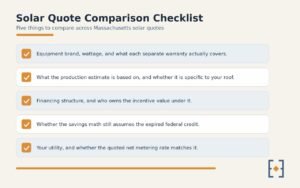
- Equipment brand, wattage, and what each separate warranty actually covers.
- What the production estimate is based on, and whether it is specific to your roof.
- Financing structure, and who owns the incentive value under it.
- Whether the savings math still assumes the expired federal credit.
- Your utility, and whether the quoted net metering rate matches it.
Request your solar quote through SolarSiteIQ to connect with a participating installer and bring this checklist into that conversation.
