
Short answer: yes, a Massachusetts solar system keeps producing through the winter. It produces less than it does in summer, and understanding that pattern, rather than treating it as a reason solar doesn’t work here, is what actually matters.
Why cold weather isn’t the problem
It’s a common assumption that cold weather hurts solar panels. In fact, photovoltaic cells run somewhat more efficiently in cold conditions than in heat; lower temperatures reduce internal resistance and can improve voltage output per unit of sunlight. The real driver behind lower winter production isn’t temperature. It’s fewer daylight hours and more cloud cover during New England winters.
What a typical winter month looks like
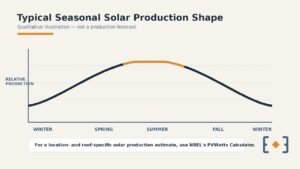
Winter output is lower than summer output, and December, November, and January are consistently the lowest-production months of the year for the Boston area. Treat any specific percentage you read, including estimates elsewhere describing a system producing roughly 70 percent of a peak month’s output in winter, as an illustrative range rather than a number that applies to your particular roof. For a real, site-specific estimate, NREL’s PVWatts Calculator models expected monthly production using your actual location, orientation, and system size, not a regional average.
The sun also sits lower in the sky in winter than in summer, which changes what actually shades a roof through the season. A tree or a neighboring roofline that clears your panels easily in July can cast a longer shadow across them in December. This is a real, roof-specific factor, and it’s part of why a shading analysis done for your actual property is worth more than a general assumption, optimistic or pessimistic, about how your home will perform in winter.
What actually happens with snow
Panels are tilted and dark, and they typically begin shedding snow once any sunlight reaches them and warms the surface. Some estimates put the resulting loss at roughly 3 percent of annual production when snow is left to clear on its own, though this varies with roof pitch, orientation, and the specific storm. It is a real, modest effect, not a reason production stops for the winter. Climbing onto a roof to clear snow yourself introduces a real safety risk and generally isn’t necessary; if snow cover is a recurring concern for your specific roof, raise it directly with your installer instead.
What this means for your bill
Because net metering credits roll over month to month rather than expiring, a strong summer production month can offset a weaker winter one, so a lower-output month doesn’t necessarily show up as a bill spike the way it might without banked credits.
Questions worth asking an installer
Ask whether the production estimate in a proposal is modeled for your specific roof, pitch, and shading, or drawn from a generic regional number. A credible proposal should be able to walk you through how it arrived at your estimate, month by month, not just hand you a single annual figure.
Request your solar quote through SolarSiteIQ to have a participating installer model your specific roof’s expected seasonal production.
