

A home battery answers two different questions, and it’s worth keeping them separate: does it keep your lights on during an outage, and does Massachusetts pay you anything for having it? The two are not the same thing.
Backup power and utility programs are different questions
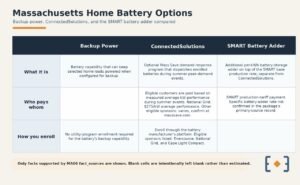
Whether a battery keeps some or all of your home running during an outage is a matter of system design: how the battery is wired, its capacity, and whether it covers your whole home or just critical circuits. That capability works regardless of whether you enroll in any utility program. Separately, Massachusetts has a specific program that pays you for letting your utility draw on that same battery during high-demand summer events. Enrolling in one does not happen automatically because you did the other.
What a battery gives you for backup
Whole-home backup versus a partial, critical-loads setup depends on how the system is designed and sized for your home, something to confirm directly with an installer rather than assume from a general description. A quote should specify which kind of backup it’s actually proposing.
ConnectedSolutions, explained
ConnectedSolutions is a Mass Save program available to battery-storage customers of Eversource, National Grid, and Cape Light Compact. It pays based on your battery’s measured average performance during a defined summer event season: events run June 1 through September 30, on non-holidays, between 3 p.m. and 8 p.m., up to 60 times a summer, each lasting up to three hours. National Grid’s own program page states a rate of $275 per kilowatt of average performance, with an incentive rate locked for the first five summers after enrollment, and participants may opt out at any time. Enrollment happens through your battery’s manufacturer platform, not directly through the utility. Treat any dollar estimate as illustrative: actual payment depends on your battery’s real, measured performance across real events, and current terms should be confirmed at masssave.com.
The SMART battery adder is a separate thing
SMART, the state’s solar production incentive, pays an additional per-kilowatt-hour adder for systems that include battery storage, on top of the base production rate. That’s a production-tariff payment for having storage as part of a SMART-enrolled system, locked in alongside the rest of the SMART contract. It is not the same mechanism as ConnectedSolutions, and it is not paid for grid-dispatch participation. A homeowner could potentially have both, evaluated and applied for separately, but neither one implies the other.
What to verify before adding a battery
Confirm which utility serves your address, since Unitil is not currently listed among ConnectedSolutions’ battery-program sponsors. Ask whether ConnectedSolutions enrollment is something the installer handles or something you’ll need to set up yourself through the manufacturer’s platform. And treat any quoted battery-program dollar figure as an estimate pending confirmation at masssave.com, not a guarantee. Separately, a home battery, like solar panels themselves, can also qualify for Massachusetts’ 20-year property tax exemption on the added value it contributes, a detail worth asking about alongside the production and backup questions above.
Request your solar quote through SolarSiteIQ and ask directly whether a battery is included, and what enrolling in ConnectedSolutions would actually involve.
