

One rule became several
Net metering in Illinois used to be a simple idea: your system sends excess electricity to the grid, your utility credits you close to the retail rate, and your bill reflects the difference. Illinois’s Climate and Equitable Jobs Act, Public Act 102-0662, changed that by removing the prior aggregate program cap and replacing it with a December 31, 2024 threshold date for ComEd and Ameren Illinois customers. Systems interconnected after that date generally move to a different crediting structure. What that structure actually looks like differs enough between the two utilities that describing it as one policy would be inaccurate.
ComEd customers
How ComEd values your net metering credits depends on which supply rate your account is on, and that’s worth being precise about rather than treating as one blanket policy. ComEd’s own program materials describe credit calculation specifically for customers enrolled in Hourly Pricing, the supply rate option that prices electricity at the hourly market price rather than a flat rate: under that structure, credit value moves with the market, so when hourly prices run higher, so does the value of exported electricity, and the reverse is also true. That description applies to Hourly Pricing enrollees specifically. It isn’t evidence that every ComEd net metering customer is credited that way; a customer on a standard or default supply rate should confirm the applicable crediting treatment directly with ComEd rather than assume the Hourly Pricing mechanics apply.
ComEd also runs a separate distributed generation rebate tied to flexible-rate enrollment: eligibility requires enrolling in a flexible rate option, such as Hourly Pricing, for the lifetime of the system. Taking the rebate is a decision with lasting effects on how the account is billed going forward, not a one-time bonus with no strings attached. Anyone evaluating that rebate should read ComEd’s current terms directly rather than treating it as free money.
Ameren Illinois customers
Ameren structures this differently. New applicants enrolling under Rider NM, Ameren’s net metering tariff, after January 1, 2025 must choose one of two crediting methods, and the choice is permanent: kWh netting, where excess generation offsets your usage directly, or monetary value netting, where excess generation converts to a dollar credit based on current pricing. Under either method, unused credits don’t expire and carry forward until used.
Ameren also offers a rebate for systems paired with a qualifying smart inverter, and accepting it changes how delivery-service crediting works under Rider NM going forward. As of June 1, 2026, Ameren expanded rate-option choice for net metering customers, giving access to a rate comparison tool through the online account dashboard. Generators above a certain size fall under a separate tariff, Rider QF, compensated at wholesale market pricing instead of the net metering structure residential customers typically use.
What actually decides your situation
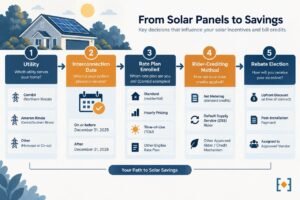
A few specifics determine which rules apply to a given account, and none of them can be answered in general terms:
- Which utility serves your address
- Whether your system was interconnected before or after the relevant threshold date
- Which specific supply rate plan you’re on (for ComEd, whether that’s Hourly Pricing or a standard rate)
- Which specific rider and crediting method applies under that plan
- Whether you’ve accepted, or are considering, a one-time rebate that affects ongoing crediting
The municipal and cooperative exception
If a municipal utility or an electric cooperative serves your address instead of ComEd or Ameren, none of the above necessarily applies. Municipal utilities and cooperatives can set their own distributed generation policies. If that’s your situation, your utility’s own tariffs are the only accurate source, not a summary built around the two investor-owned utilities.
Where to check the current rules yourself
The Illinois Commerce Commission’s Climate and Equitable Jobs Act implementation page tracks the regulatory filings behind these changes, including the utilities’ own proposed terms and conditions under Section 16-107.5 of the Public Utilities Act. For your specific account, your utility’s current published tariff is the definitive source.
Request your solar quote through SolarSiteIQ and ask a participating installer to show you the specific rider and crediting method they’d propose enrolling your system under.
Frequently asked questions
Am I grandfathered under the old net metering rules?
It depends on your interconnection date and, in some cases, on choices you make afterward, like accepting a rebate. Confirm with your utility using your actual account and interconnection date.
Is ComEd’s net metering the same as Ameren’s?
No, and neither is a single uniform policy within itself. ComEd’s Hourly Pricing enrollees are credited at the hourly market price specifically; other ComEd rate plans may be credited differently, and that’s worth confirming directly with ComEd. Ameren requires new applicants to choose a permanent crediting method between usage netting and monetary netting. All of this differs enough by utility and by rate plan that a general comparison only goes so far.
What if I’m not served by ComEd or Ameren?
Municipal utilities and electric cooperatives can set their own distributed generation policies. Don’t assume these statewide changes apply to you; contact your utility directly.
