

Net metering is the mechanism that turns extra solar power you generate into a lower electric bill. How it actually works, and how much it’s worth, depends heavily on which utility serves your home.
What net metering means for your bill
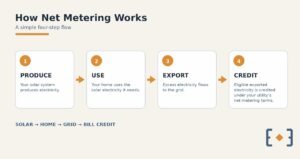
When your system produces more electricity than your home is using, the excess is exported to the grid, and your utility credits your account rather than cutting you a check. That credit then offsets electricity you draw from the grid later, when your panels are not producing enough, such as at night.
The credit, and what “close to full rate” actually means
For Massachusetts’ three investor-owned utilities, Eversource, National Grid, and Unitil, residential systems up to 25 kilowatts are credited close to the full retail rate for every kilowatt-hour exported. National Grid itself describes this as letting a customer “export any excess electricity to the electric grid in exchange for credits that are nearly equal to retail rates.” The qualifier matters: a small set of non-bypassable charges can be excluded from what’s credited, so the effective rate a household actually sees can run slightly under the full posted rate rather than exactly matching it.
Does your utility matter? Yes, a lot
This is the first thing to check, before anything else in this article. If you’re served by Eversource, National Grid, or Unitil, the structure above applies to you directly. If your town runs its own municipal light plant, roughly 41 Massachusetts towns do, that structure does not apply. Municipal light plants are not required to offer the same net metering terms, and while most offer some form of export credit, the rate and rules are set independently by each one. If you’re not sure which kind of utility serves your address, that’s the first call to make before evaluating a solar proposal’s savings math.
What happens to unused credits
Credits roll over month to month and do not expire, so a strong-production month in the summer can offset a lower-production month later, rather than being lost if you don’t use it right away.
A live regulatory question worth knowing about
In December 2025, the state Department of Public Utilities opened an investigation into gas and electric delivery charges and bill design generally. Net metering’s credit value is one of the specific questions the Department said it would examine as part of that broader review, comparing Massachusetts’ current approach to other states. As of this writing, that investigation is open and no ruling has been issued. The 1:1-style crediting described above remains fully in effect. This is worth knowing about, not worrying about: nothing has changed yet, and this article will be revisited as the docket moves forward.
How this fits into a quote
If you’re comparing proposals, ask a participating installer to show you the specific crediting method they’d model for your utility rather than assume a generic statewide number, and treat any production savings estimate as tied to that specific rate.
Request your solar quote through SolarSiteIQ and ask a participating installer to show you the specific crediting method they’d propose for your utility.
