
An option many homeowners don’t know exists
Most solar coverage assumes paying for a system one way or another, in cash, through a loan, or through a lease. Illinois Solar for All works differently: it’s a state program built specifically to expand solar access to income-qualified households.
What the program is
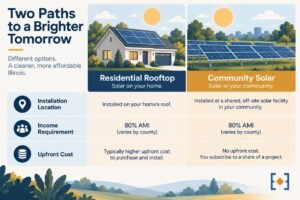
Illinois Solar for All is a state program, separate from Illinois Shines, focused on households and communities that have historically had less access to renewable energy. It has two residential paths: Residential Rooftop Solar, which installs panels on your own home, and Community Solar, which lets you subscribe to a shared project elsewhere and receive bill credits without anything installed at your address. These are genuinely different arrangements, and which one fits depends on individual circumstances, not a single default answer.
Who qualifies
Eligibility is based on household income relative to the Area Median Income, or AMI, for the county you live in. Illinois Solar for All uses an 80 percent of AMI threshold for the residential rooftop path, and because AMI varies by county and household size, there’s no single statewide income number that applies to everyone. The only reliable way to check is the program’s own income-eligibility lookup tool, using actual household size and county.
What the residential rooftop program provides
For eligible households, the program is structured so there’s no upfront cost to the homeowner for the rooftop installation itself, with the program specifically designed so that monthly energy savings are expected to exceed any ongoing subscription or loan payment tied to the system. That’s a different value proposition than the loan and lease options most homeowners weigh, worth evaluating on its own terms.
Your home still needs to work for the project
Income eligibility is one requirement. The home itself needs to be workable for a solar installation too, which is assessed project by project rather than against one fixed checklist. Roof condition, remaining roof life, structural capacity, and shading all factor in, similar to any solar project, and the program’s Approved Vendors evaluate these specifics as part of enrollment rather than a homeowner needing to pre-qualify their roof independently.
Timing and capacity affect participation
Unlike a standard purchase, where someone can generally start whenever they’re ready, Illinois Solar for All runs on defined program-year submission windows, and enrollment happens through the program’s Approved Vendors, not directly by the homeowner. Program categories can reach their allocated capacity and close before a window’s official end date, so availability isn’t guaranteed just because a household is income-eligible. If this program interests you, working with an Approved Vendor sooner rather than later matters more than it would for a standard purchase.
How to actually check eligibility
Illinois Solar for All maintains an official income-eligibility lookup tool, and the program enrolls participants through its own network of Approved Vendors. Checking your real eligibility and working with an Approved Vendor for this specific program is the accurate path. A participating SolarSiteIQ installer may or may not be an Illinois Solar for All Approved Vendor specifically, so if this program is what you’re after, confirm that directly with whoever you’re working with.
If you think you might qualify, or want to compare this option against a standard purchase, request your solar quote through SolarSiteIQ, and ask directly whether the installer you’re connected with participates in Illinois Solar for All specifically.
Frequently asked questions
Is Illinois Solar for All the same as Illinois Shines?
No. Illinois Shines is the state’s broader renewable energy credit program, generally available to solar owners. Illinois Solar for All is a separate, income-qualified program aimed at households who might not otherwise access solar at all.
What’s the difference between the rooftop and community solar options?
Residential rooftop solar installs panels on your own home. Community solar lets you subscribe to a shared project elsewhere and receive bill credits without any installation at your address. Which fits depends on individual circumstances.
How do I know if my household qualifies?
Use the program’s official income-eligibility lookup tool with your actual county and household size. There’s no single statewide income cutoff that applies to everyone, and eligibility alone doesn’t guarantee immediate enrollment, since program capacity and timing also affect participation.
